VSAT Network Types |
|
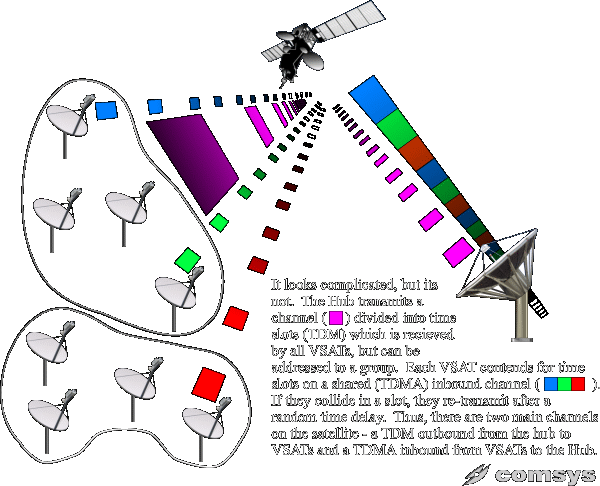
This is how a star data, TDM/TDMA VSAT network works using a hub station, usually six metres or more in size and small VSAT antennas (between 75 centimetres and 2.4 metres). All the channels are shared and the remote terminals are online, offering fast response times. Historically, TDM/TDMA systems competed with terrestrial X.25 or frame relay connections, but as VSAT transmit data rates have risen beyond 2 Mbps and receive rates can now meet or exceed 100 Mbps DSL and MPLS services have become the main competitors in most markets.
Initial systems were designed to offer fast response times for predicable, bursty traffic patterns - typified by credit verification transactions and lottery systems. As the internet and broadband generally began to drive demand, the manufacturers introduced completely new IP-centric platforms designed to serve broadband applications. In essence, current systems are now also able to trade a short initial delay to allow the hub to allocate dedicated capacity within the inbound (return) channel to a VSAT. This capacity is dynamically sized by the system based on the traffic demand seen by the VSAT. In addition, all systems also incorporate frequency hopping, allowing the network to be load-balanced by moving VSATs between inbound carriers to ensure that capacity is used efficiently and congestion does not occur. The first generation systems all employed proprietary TDM outbound channels, but the advent of the DVB-S standard bringing extremely low cost broadband demodulator chips to the market caused almost all of the vendors to adopt it as the basis for their outbound/forward channel. The basic time divided slot architecture remains the same however. Cost was the primary driver because the video-centric design of DVB-S was not very efficient for pure IP services. Most recently, the introduction of the latest DVB-S2 and now DVB-S2X standard has dramatically changed this situation with low cost and efficiency now features. The DVB-S2X standard brings efficiencies of up to 40% over DVB-S and the addition of ACM (Adaptive Coding & Modulation) can add a further 40%. In the past, broadband VSAT systems were sometimes criticised for poor performance with the blame often being laid at the door of the product. However, almost every VSAT platform of which we are aware, is very capable of meeting the demands of the most demanding user - the culprit for poor performance was (and often still is) usually a result of the amount of bandwidth a subscriber is allocated as part of the service. For many years satellite bandwidth was both a finite and expensive resource, but over the past two to three years a dramatic downward trend has begun and the satellite industry has begun to experience the same effect as the fibre and cellular sectors - bandwidth is becoming a low priced commodity. This is a cost equation that Ka-band spot-beam satellites have initiated along with pressure from growing competition from alternative technologies and the desperation on the part of the satellite operators as their historic "sit back and milk the DTH cow" days are looking less bright. The industry has also introduced greater efficiencies and throughput at the ground segment level - inbound/return links now support much higher coding rates and adaptation catalysed by HTS Ka-band spacecraft and all manufacturers are constantly working on more advanced techniques to manage IP and web traffic (acceleration, compression and caching) as well as other developments as part of ongoing activities to push the boundaries of the technology and keep it competitive. Aside of the fact that, like the beer commercial, satellite reaches parts other technologies cannot - the unified, ubiquitous, predictable and reliable nature of the solution continues to find applications all over the world in both developed and developing markets. LEO services will fix the biggest problem - high rates of latency - and then the industry will be back in the mainstream.
|
|
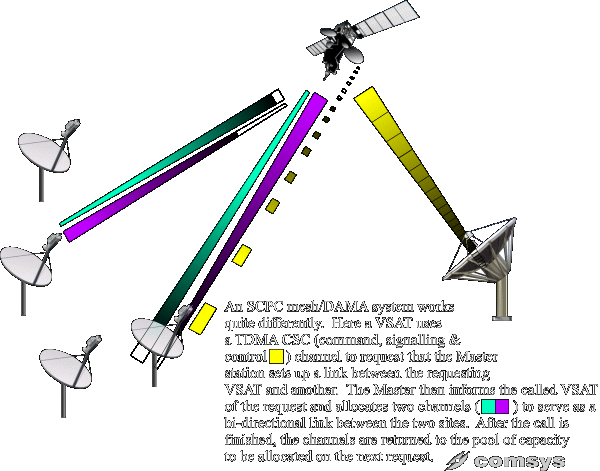
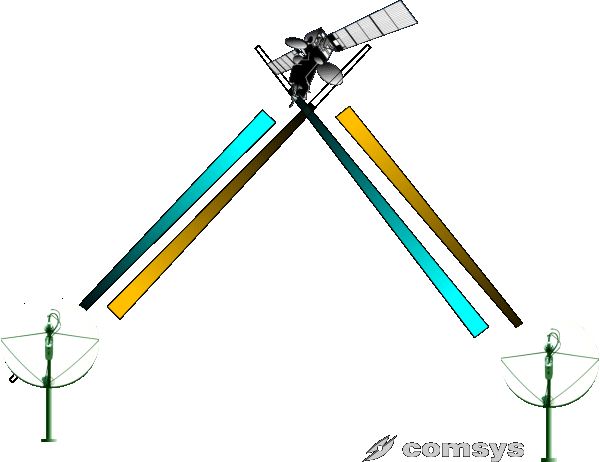
Mesh networks which use capacity on a demand assigned multiple access (DAMA) basis take a different approach. The master control station merely acts as a controller and facilitator rather than a hub through which traffic passes as in a star network. However, these connections take a little time to set-up and thus, mesh/DAMA systems are often equated to a terrestrial dial-up connection.
|
|
There are also mesh systems which use a TDMA access scheme where all of the terminals in a network receive and transmit to the same channel, selecting different time slots because each terminal is aware of what the others have reserved. In the past these types of system have been costly and therefore, reserved for large scale trunking applications, but, more recently, prices have come down considerably and now they can be cost competitive with SCPC/DAMA systems for thin route applications as well. Now that pretty much all the star TDMA system vendors have systems capable of data rates in excess of 100 Mbps, the high-end SCPC and DAMA products have lost their big advantage. The most powerful VSAT terminals in a manufacturers' product range are priced at a slight premium to a standard VSAT, but are also often able to carry much greater network functionality so traditional full-mesh systems have increasingly found their markets mainly in highly specialised, niche markets running Air Traffic Control, Defence and Satellite News Gathering (SNG) applications.
Point-to-point SCPC (single channel per carrier) links are the satellite equivalent of a terrestrial leased line connection. They are usually set-up on a permanent, 24 hour basis and are thus more costly in satellite capacity and less efficient if not used all the time. However, they do support dedicated high bandwidth links without any sharing or contention. We used only classify terminals running rates from 9.6 kbps to 2 Mbps as VSATs because data rates higher than 2 Mbps often required extremely large antennas that were expensive and could hardly be described as "Very Small Aperture" any ). Today this is no longer the case and we simply try and exclude any type of installation that is much more than 3.6 metres.
|
|
All other systems are usually a variation on one of the themes described above, either in a star, mesh or hybrid (star and mesh) configuration.
|