|
For your interest, here are a few statistics and figures about the VSAT market.
You have our permission to quote these figures providing that you label any information
you
use
as
© and reference is made at each use to this www site
(www.comsys.co.uk). These statistics include sales up to the end of 2016
although service sites are based on a 12 month research timeframe: and reference is made at each use to this www site
(www.comsys.co.uk). These statistics include sales up to the end of 2016
although service sites are based on a 12 month research timeframe:
| Enterprise & Broadband Star Data Systems |
|
| Total Number of Enterprise VSAT Terminals
Shipped |
4,597,805 |
| Total Number of Sites in Service |
1,565,662 |
| Enterprise Sites in Service 3 Year CAGR |
1.3% |
| Number of Contracts Listed in the COMSYS Database |
33,694 |
| Number of Active VSAT Operators Tracked by COMSYS |
537 |
|
| Consumer Internet Access Star Data Systems |
|
| Total Consumer Sites in Service |
2,203,346 |
| Total Consumer VSATs Shipped |
6,986,801 |
| Consumer Subscribers in Service 3 Year CAGR |
5.7% |
|
| DAMA Systems |
|
| Total Number of Mesh/DAMA
Terminals Shipped |
198,210 |
| Total Number of Thick & Thin Route Mesh/DAMA Sites in
Service |
39,899 |
| Sites in Service 3 Year CAGR |
1.6% |
| Number of Contracts Listed in the COMSYS Database |
6,003 |
|
| SCPC Systems |
|
| Number of Sites in Service |
29,841 |
| Links in Service 3 Year CAGR |
-4.4% |
|
| VSAT Revenues |
|
| All Service Revenues |
$8.16 billion |
| TDMA & DAMA Hardware Revenues |
$0.96 billion |
|
|
There are now
fewer different
star and mesh TDMA and DAMA systems from many vendors - The
14th Edition of The VSAT Report lists
23 different products - but currently the star data market is
primarily contested by Hughes Network Systems (with its HX and HT/Jupiter systems), Gilat Satellite Networks (with its SkyEdge II-c and SkyEdge
II products), ViaSat (with the
SurfBeam 2, ArcLight and SLQ systems), iDirect (with the Evolution
and Velocity platforms), Newtec (with Dialog) and several standards-based DVB-RCS system
vendors which include Advantech, Satlink (previously STM), ASAT (previously NanoTronix) and Thales Alenia
Space.
Others include Advantech's InterSKY (which was Shiron), UHP Networks (which
changed name from Romantis) and TSAT. In the DAMA market the main
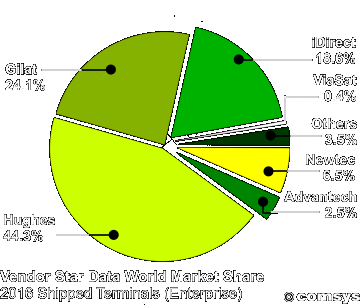
players are Comtech, ND Satcom, Polarsat and ViaSat with LinkWay. The figure opposite shows the vendor
market share measured by the number of terminals shipped in 2016:
|
|
|
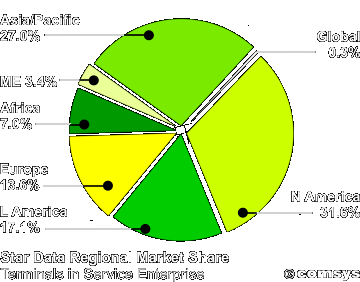
The regional market for VSAT systems
has historically been
dominated by North America, especially in terms of volumes and it still is
when taking into account consumer services.
However, in the enterprise segment the other regions have been catching up since 1988 and have, until
relatively recently, been
higher margin markets. Africa and the Middle East grew very strongly
through 2009, but fell back as demand in both regions evolved to reflect
the advent of international fibre in Africa and the changing military situation
in the ME. As government sponsored broadband projects have grown in
importance, so the developing regions of the world have begun to see greater
volume sales than the gradually declining North American market. |
 |
|
The
launch of new Ka-band satellite systems from Yahsat, Avanti and Eutelsat
initially helped, but most of these service businesses, which began by
targeting the consumer segment, have not performed very well over the past
three to five years.
Western Europe retains its position as the world's hub, but both enterprise
and consumer sales within the region have been sluggish for many years. Further east, Russia
continues to drive demand, but the market there has been pretty flat
recently while other countries have declined in activity. Brazil
and Mexico are the engines of growth for Latin
America, but all of the major nations continue to show pretty robust demand for
VSAT services particularly from the government, carrier and financial
segments. With Hughes' successful launch of its consumer service in
Brazil in mid-2016 and growing HTS capacity deployments, there are now good
prospects based on solid performance for consumer services in some of the
developing markets.
India is a law unto itself,
both in terms of its unrelenting and imaginative use of the technology as
well as the determination of the major operators to open up new
opportunities despite the bureaucratic restrictions that the government
departments that regulate the space industry place in front of them.
Elsewhere Indonesia, Malaysia, Myanmar and Australia are the hot spots in Asia
with some hoped for prospects in China.
Demand for broadband access services from
small businesses was strong for several years, but as Ka-band spot-beam
satellites have emerged with the promise of massively increased bandwidth
and lower costs, the market has begun to transition as operators and
customers prepare for new services. |
|
To date over
4.5 million star TDMA sites have
been sold to core enterprise customers, such as Yum!, Mobil/Exxon, the US
Postal Service, BP, Rite Aid, Walgreens, GTECH, Wal-Mart, McDonalds, Best Western and Safeway
(see the user examples for
more information). 2001 saw the initial growth of consumer internet
access services, which are most successful in the US, although service
initiatives are growing in Lain America, Europe and Africa. Managed broadband access services targeted at the SME
segment have seen a gradual decline as the
commercial launch of these consumer services has gathered pace.
Mobility has been the prime area of growth - maritime, military, emergency
services, O&G and
aeronautical. These segments are
relatively small in volumes, but high in relative revenues.
|
 |
|
In the fixed market the biggest segment of
growth is seen in the cellular backhaul market - ironic because cellular
data services have emerged as the largest competitor to VSAT over the past
three to five years. As a consequence of this, rapidly expanding fibre
coverage and many new technical and product innovations in the
VSAT/satellite industry, the market has entered a much more volatile state -
something that was a feature of the industry a few years ago.
Increased demand for bandwidth alongside the
need to ensure business continuity has meant that hybrid mixed VSAT/terrestrial networks are now far more common.
However, this has also led to fast growth of consumer services which tails
off quickly as bandwidth is saturated. HughesNet and Exede have shown
that substantial and sustainable growth in consumer markets is possible
following the extremely successful introduction of their new
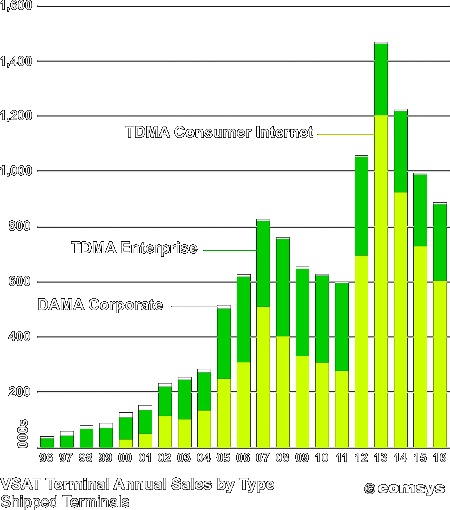
generation of Ka-band satellites. The rapid saturation of available
capacity as demand accelerates is well documented in the number of consumer
terminals shipped year to year since 2004. |
|
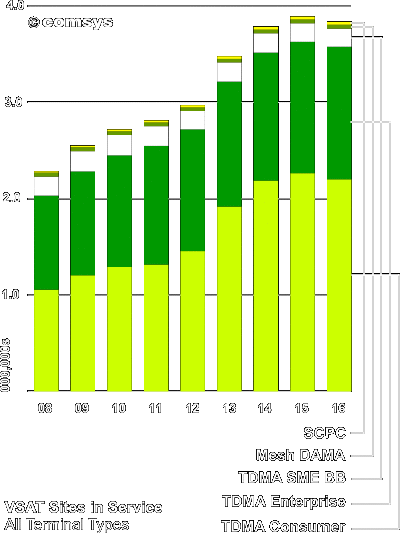
Overall, the
total number of satellite sites in service continued to grow up to 2015 with
the drop off in 2016 a result of the US consumer capacity saturation.
Taking consumer out, the performance of the enterprise side of the market
has been disappointing showing very little growth in the number of sites and
a decline in revenues as service is shifted from primary to backup.
The site count increased - almost
4 per cent between 2014 and
2016 - whilst the volumes of data consumed has shot up. Operators face
constant price pressure and falling satellite capacity pricing has actually
made this worse rather than easier. With the move to universal, often
controlled, gateway infrastructure for spot-beam systems and increasing
competition from space segment suppliers VSAT operators face considerable
challenges even as the satellite operators themselves struggle to come to terms with a rapidly changing market
environment. VSAT service providers have invested heavily in new
platforms introducing increased efficiency wherever possible and the past
three years saw the system vendors catch up with a vastly more powerful generation of
products.
Growth segments in
the core enterprise markets include networks for lotteries, banking ATMs,
government projects and utilities as well as hybrid business continuity,
carrier extension and cellular backhaul in the enterprise
segment. Corporate services are also seeing demand for new sites and higher
data rates in the specialised vertical segments including oil & gas,
disaster and emergency, mining, military, aeronautical
and maritime.
|
 |
|
|
|
|
|