|
For your interest, here are a few statistics and figures about the
maritime VSAT market.
You have our permission to quote these figures providing that you label any information
you
use
as
© and reference is made at each use to this www site
(www.comsys.co.uk). These figures run into 2014, but are not
complete for the whole year: and reference is made at each use to this www site
(www.comsys.co.uk). These figures run into 2014, but are not
complete for the whole year:
|
There are a number of segments within the maritime niche which have been
very well targeted and are now saturated not least because of the O&G
downturn even though this remains one of the largest segments in terms of
revenues. These include O&G rigs & platforms with the leading providers
being Speedcast, RigNet and ITC Global; cruise
lines, with SES/O3b and Speedcast who are the largest in this segment that
now has many more operators; oil & gas supply Marlink,
RigNet, KVH, Inmarsat, BlueTide, SpeedCast and other O&G specialists); and,
ferries Marlink, TSBC and Telespazio.
These sub-segments are small in volume – less than 4,500 ships in total –
but very high in value. The related market in the oil and gas business is broken out as maritime in the latest COMSYS Maritime
VSAT Report. This includes supply vessels, seismic vessels
and dive support services. There has been more competition and
entrants into these segments and the market disruption we predicted in our
last report has happened.
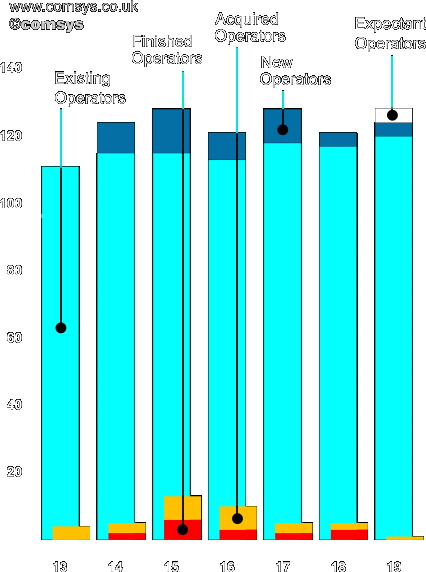
Changes over the
past couple of years in
the demand for broadband at sea and the pressures in the land-based market have increased the number of
operators deploying stabilised antenna systems
from a handful of very specialised companies to more than 120 service
providers across the world all interested or providing some form of VSAT
service to the maritime industry. At the same time there have been
many smaller operators close down as well as a great many acquisitions. There
continues to be greater penetration of the lower levels of the market which comprises several sub-segments that are both regional and international in scope.
The saturation of the high-end segments together with the wider
commercial segment now seeing broadband at sea as an essential
requirement to both retain crew and adopt more value-added services which
help reduce operational costs has now brought the commercial .segment as the
number one in terms of both vessels in service and revenues.
|
|
|
Now that the old
issues of ocean coverage of bandwidth by satellites has gone away, service
pricing has become more commoditised and a growing move towards smaller
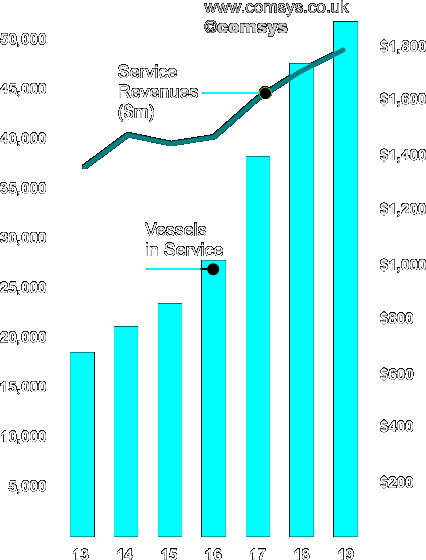
stabilised antennas, the growth of the number of vessels with VSAT has
exploded since 2016.
Recent growth of maritime VSAT services has been extremely vibrant as
commercial fleets the world over have increasingly thrown away the
inhibitions so evident in past years. All
stabilised antenna VSAT services have shown strong long term growth in the
number of vessels served with growth
at 3 year compound annual rates having risen from 10% to 20% between 2016
and 2018. Although due to some of the points made above as well as
others, like rapidly falling bandwidth prices, the revenues during this
period (2016-2018) only grew by 5%.
A big part of all
this is the fact that the fishing business
has seen a sea-change (pun intended yet again!) as the Chinese government
introduced a subsidy for the service and the number of fishing vessels
connected grew exponentially in the last three years. There are
challenges with this very low cost government initiated service for
operators and manufacturers, but other countries are also looking to adopt
similar programs based on various security reasons. In our opinion the wider
commercial tanker, container and freight market is the most attractive area
of growth for maritime VSAT operators for the next three to five years as fleet owners and
operators have finally accepted the criticality and utility of broadband and
the fact that VSAT services represent an important tool to lower costs and
retain crew. However, with new pollution regulations being imposed,
vessel owners may have financial challenges as they are forced to upgrade
and modify their ships to meet these compliances.
The addressed customer base has broadened quite considerably and average prices
and margins have continued to reduce. This, smaller antennas, the
heavier move into the fishing market and other things have expanded the
potential numbers of vessels that may be connected with VSAT in the future
versus the way that VSAT was considered to be a highly expensive good
bandwidth service that only the really rich vessels could afford once upon a
time.
|
 |
|
The maritime
industry now enjoys a far greater diversity of choice in hardware, software and
service as well as the proposed GEO, MEO and LEO satellite developments all
of which are heavily promising to change the market. Most successful
operators have adopted value-added services as part of their integrated
connectivity and antenna manufacturers, led primarily by Intellian, have
brought more simplicity, reliability and lower operational costs.
MSS services are
clearly important and play an essential role for safety and back-up
services, but the lower bandwidth and higher pricing that L-band services
have to bear has now ensured that MSS is more of a complement than a
competitor to VSAT. Revenues from stabilised VSAT services (which
include bundled hardware) grew to almost $1.8 billion in 2014 and the
number of vessels, including rigs and platforms, in service closed in on 52,000
in 2019.
The
5th Edition of the COMSYS Maritime VSAT Report analyses the total available maritime market
based on primary research, publicly available data and specific data points
from industry contacts. With all the changes mentioned briefly above,
the report shows that there are over 3
million vessels of all types that could theoretically be connected by
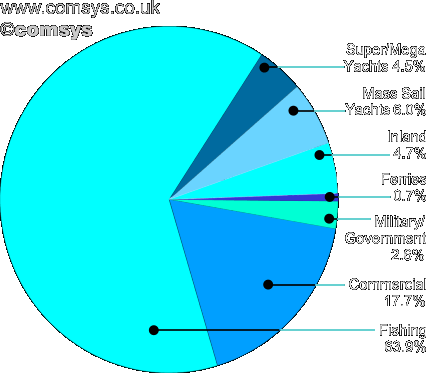
satellite services and that, after removing the small yacht and fishing market,
now only 137,000 vessels represent the core opportunity of which almost 38 per cent are
actual or near term potential
customers for VSAT. The breakdown of these vessels by segment can be
seen in the pie chart above.
|
 |
|